AI document review just became table stakes.
The deployment model courts are starting to require is still unbuilt.
In the last year the major eDiscovery platforms folded generative-AI review into their base
pricing. The capability stopped being a differentiator. At the same time, courts began
restricting which AI may touch confidential evidence at all — and the honest answer to that
restriction is architectural, not contractual. That is the company.
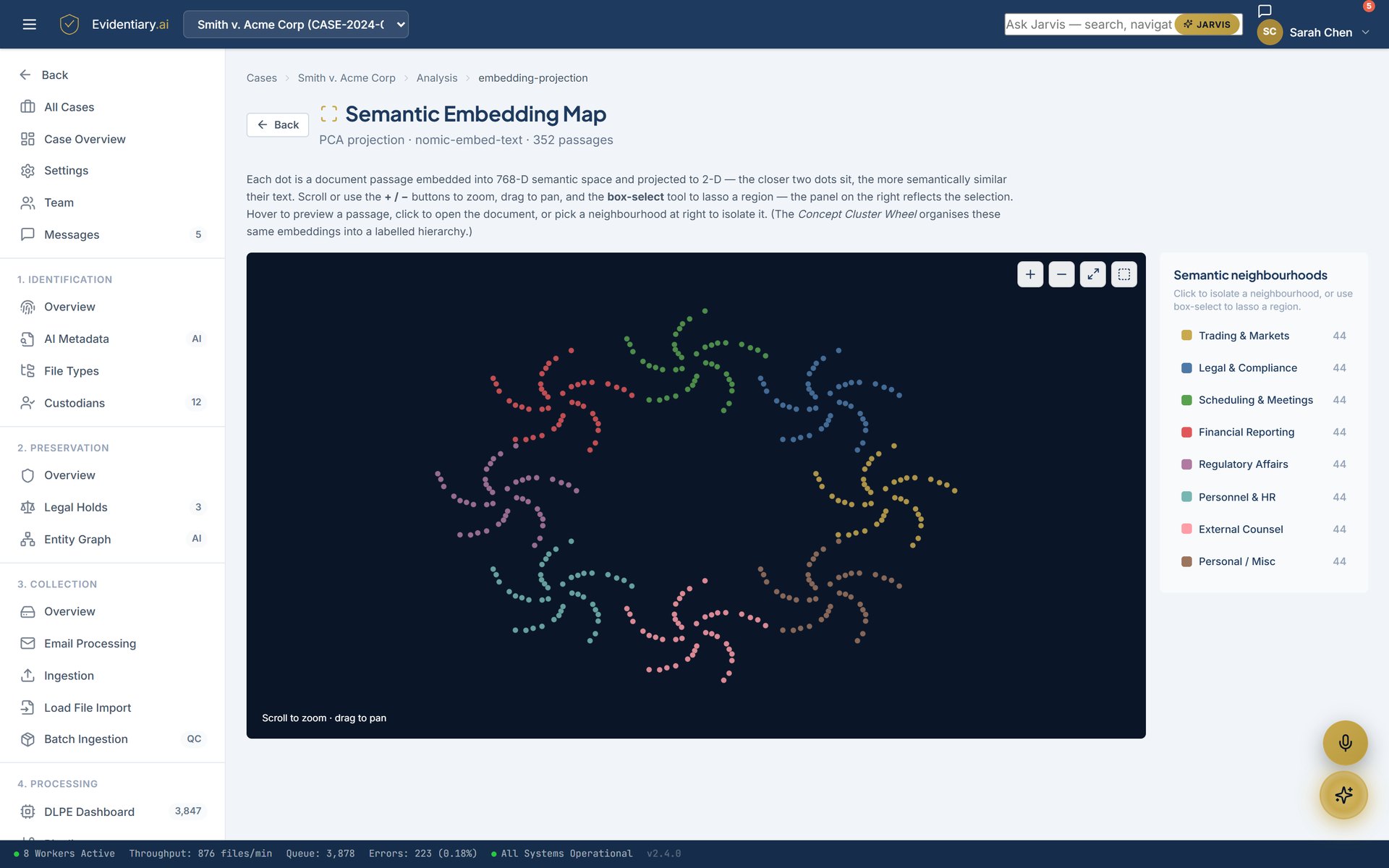
Semantic embedding map
Every passage in the corpus, plotted and clustered by meaning. Live product, demonstration matter.
The application
See the case — don't just search it.
Most platforms give you a query box and a results list. Evidentiary.ai turns the corpus into
pictures a trial team can reason about — and every picture drills down to the underlying
documents.
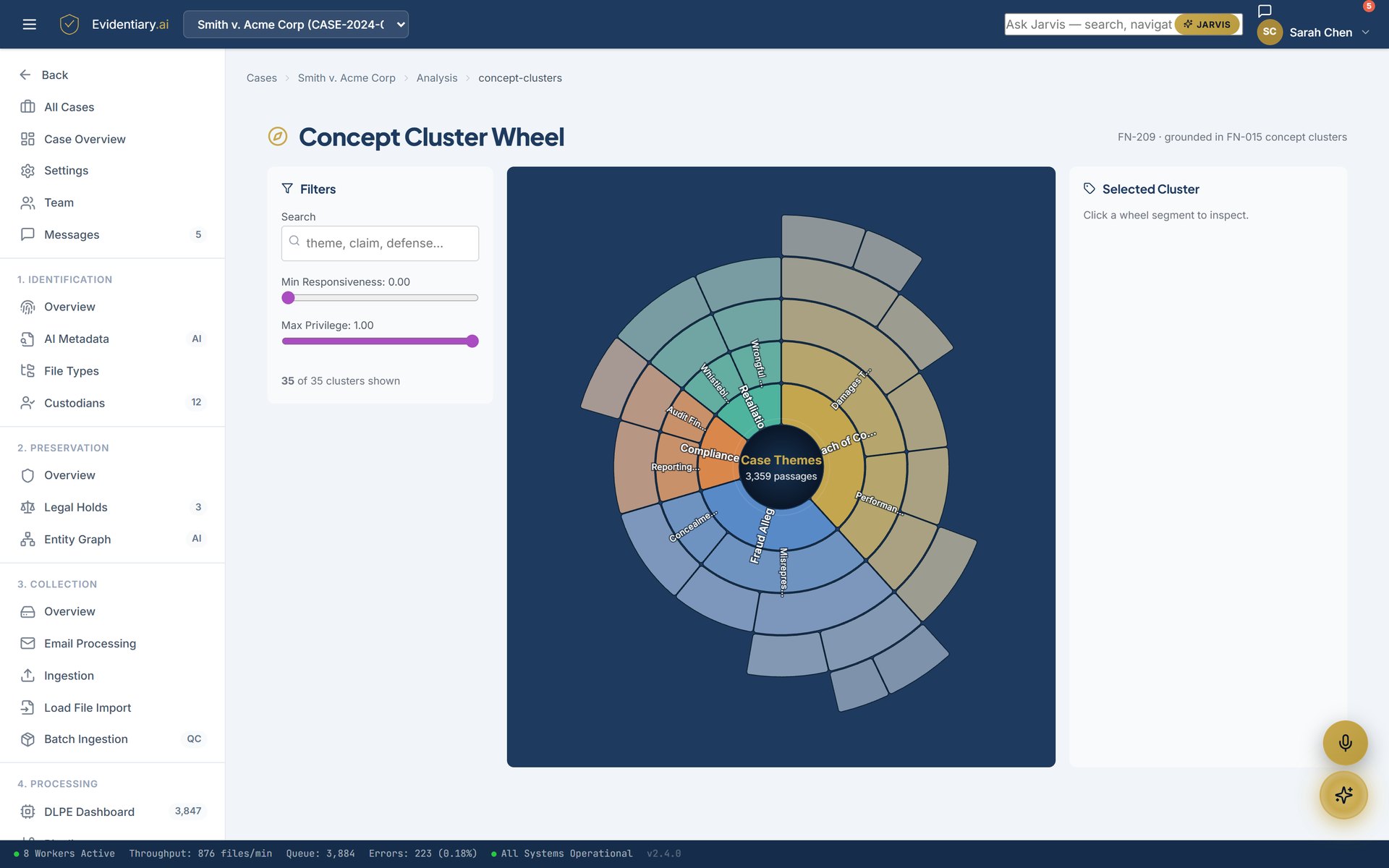
Every theme in the case, on one wheel.
The Concept Cluster Wheel organises the entire corpus into a radial hierarchy of themes —
fraud allegations, compliance, damages — sized by how much of the record they cover. Click a
segment to isolate its passages and jump straight to the documents behind it.
Concept cluster wheel
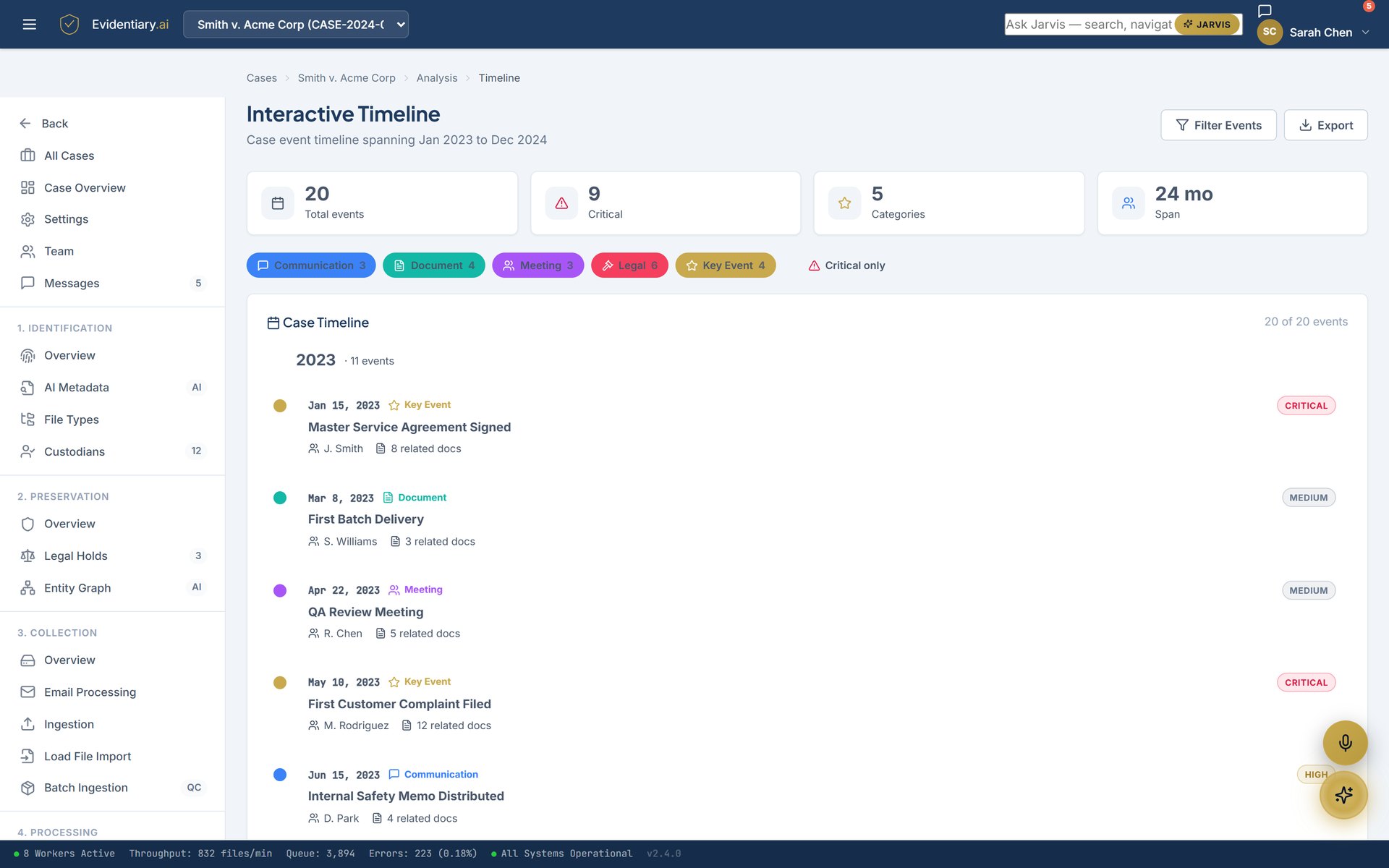
The story of the case, in order.
Key events, communications, meetings, and filings on one interactive timeline — flagged by
severity, linked to custodians, and tied to the related documents. The narrative your opening
statement needs, assembled from the evidence itself.
Interactive timeline
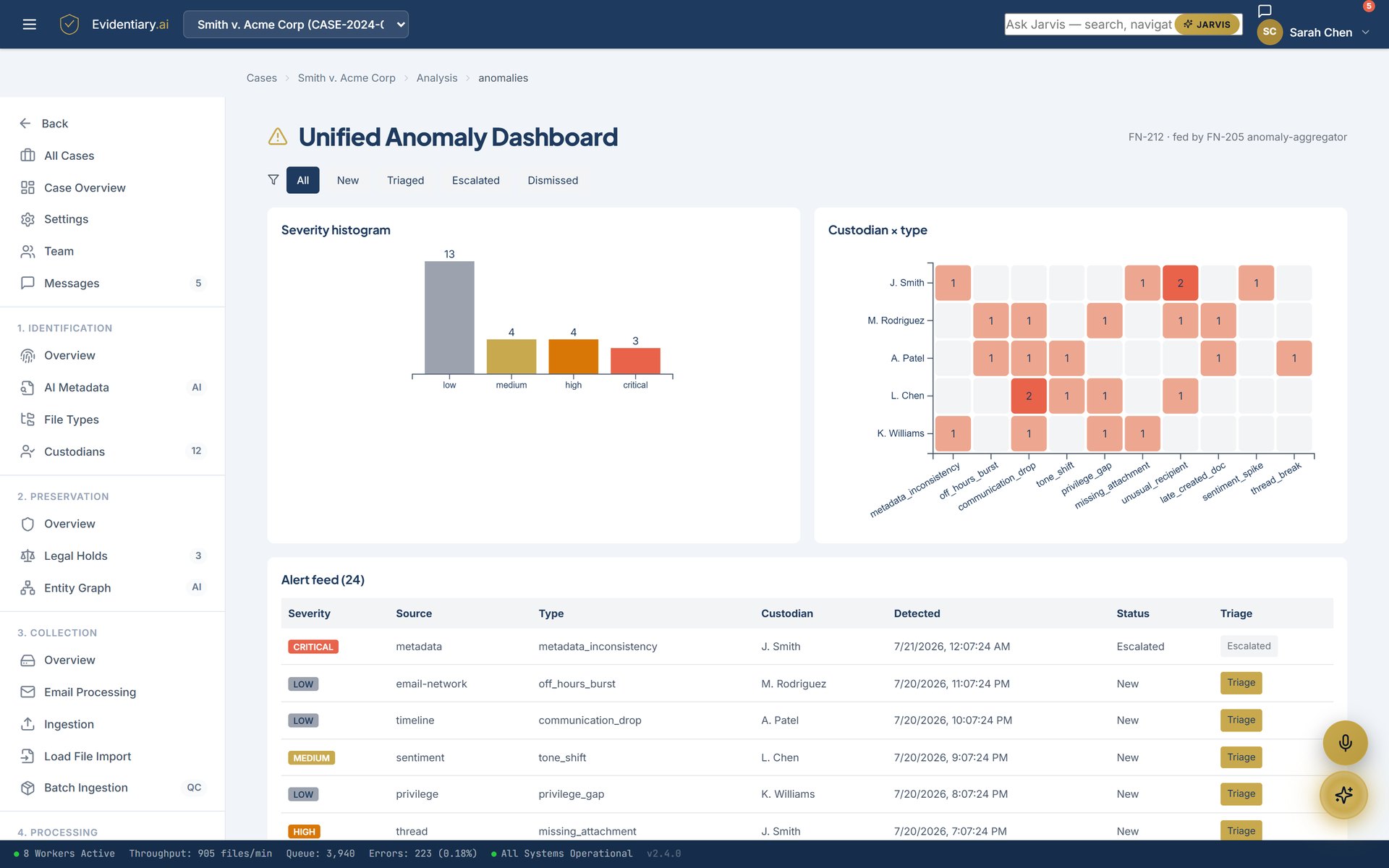
The documents that don't add up, surfaced.
Metadata inconsistencies, off-hours bursts, communication drops, tone shifts, privilege gaps —
anomaly signals from every analytic, aggregated into one triage queue with a
custodian-by-type heatmap. Spoliation patterns stop hiding in the volume.
Unified anomaly dashboard
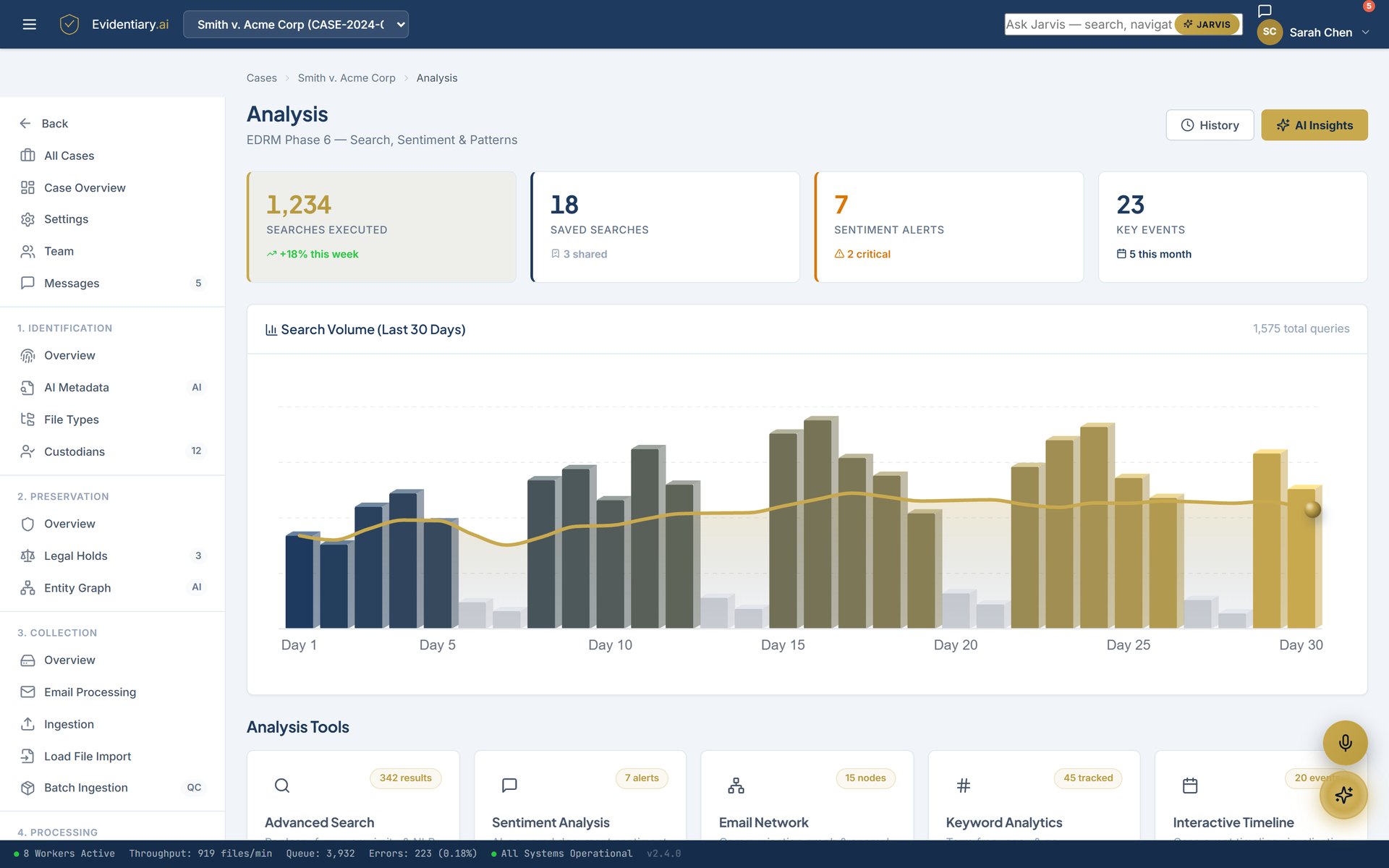
Search, sentiment & patterns — one dashboard.
Search activity, sentiment alerts, and key events at a glance, with the full toolkit one click
away: advanced search, email network graphs, keyword analytics, entity extraction, and
natural-language inquiry with cited answers.
Analysis command center
Screenshots are the live product rendering a fictional demonstration matter — not mock-ups.
What actually exists
This is a working platform, not a prototype.
The most common failure mode in this category is a demo with a services company behind it.
What follows is measured from the build itself, and stated with its limits.
9 / 9
EDRM phases covered
Identification through in-court presentation, on one case file and one audit ledger — not an integration of separate products.
210
of 217 functions pass live validation
Verified by automated HTTP probes against running services, not by a checklist. The remaining seven are front-end and library functions with no service endpoint to probe.
164
services, plus a Rust forensic engine
Across 26 architecture layers. Document processing, OCR, and rendering are built in-house in Rust rather than outsourced — the layer most review platforms buy or partner for.
Figures are drawn from the build's own manifest and its most recent automated validation run.
The platform is pre-launch and in active development. We publish no accuracy or throughput
benchmarks, because we have not yet run and validated them to a standard we would defend in a
deposition. That work, and its current honest state, is covered in the pitch.
Why now
Three things changed inside twelve months.
Each is a matter of public record. Together they describe a market that has commoditised the
feature we are not selling, and opened a gap we are.
01
GenAI review got bundled.
Between late 2025 and early 2026 the leading platforms moved generative-AI review into all-inclusive per-gigabyte pricing. Selling "AI review" as a premium feature is over. Whoever competes on that axis alone is competing on price.
02
Courts declined to treat it as special.
The first significant ruling on generative-AI review held it to be a form of technology-assisted review under the existing rules, rather than a novel methodology deserving heightened scrutiny. The bar to adoption came down, not up — which accelerates the whole category.
03
But protective orders started drawing lines.
Courts have begun restricting the use of mainstream AI tools on confidential material unless the provider is barred from retaining or training on what it sees. Cloud vendors answer that with a contract. Only local architecture answers it structurally.
The wedge
A dated migration event, with nowhere to migrate.
Relativity has publicly announced that its on-premises Server product will accept no new
matters after January 1, 2028. The firms, agencies, and defense teams that chose on-premises
deployment for a reason — classified work, sealed matters, confidentiality obligations that a
contract does not satisfy — have a fixed deadline and no like-for-like destination. No major
platform offers air-gapped generative-AI review today.
The incumbents can't follow quickly.
Their AI is architecturally bound to third-party cloud models. Serving this segment is not a feature they can ship; it is a rebuild of the thing their economics rest on.
Deployment is the moat, not the model.
We do not claim a better model. We claim the only place some evidence is permitted to be processed — on hardware the client controls, with no outbound inference.
Marginal inference cost is structural.
Self-hosted models change the unit economics of AI review rather than the sticker price. What that permits commercially is covered in the pitch.
Sources for each of the above — rulings, vendor pricing announcements, and the underlying
competitive research — are cited in full in the pitch materials.
Who is building it
This wasn't designed in a lab.
The deployment constraint at the centre of this company is not a market theory. It is the
daily operating reality of the largest civil litigation program in the United States — run,
for over a decade, by the person building the platform.
Joshua Wood spent over two decades at the Department of Justice and over a decade as the
Director of the Office of Litigation Support for the Civil Division — building and managing
the most advanced litigation support environment in the federal government.
At DOJ, Josh oversaw a $90–$120 million annual operation spanning 500+ staff, a
petabyte-scale data infrastructure, and twelve FISMA-authorized systems. He served as a
Department recognized subject matter expert on AI in litigation, delivering training programs
on text analytics and predictive coding across DOJ's litigating divisions.
He served as the "Tier 3" E-discovery technical lead, advising attorneys and agencies, and was
the technical member of DOJ's eLitigation Steering Committee. Evidentiary.ai is the product of
everything he learned building litigation technology at that level — now available to every
litigation team that demands defensible, auditable AI.
$11M+ annual savingsThe ADAM Lab, conceived and built by Josh, delivered over $11M in annual cost savings for DOJ — recognized as the Department's most successful technology project.
12 FISMA authorizationsInformation System Security Owner for twelve Authority to Operate environments, including the Department's first high-side (S/TS) litigation deployment.
$1.5B contract technical leadTechnical Lead for MEGA5, the Department's $1.5 billion litigation support procurement vehicle, advising the Contracting Officer on programmatic requirements.
5 automated litigation labsDesigned and deployed five ALS Labs handling eDiscovery processing, FOIA, and forensic analysis for the Civil Division — delivering $8M+ in annual savings.
Enterprise platform launch in 3 weeksLed the expedited launch of Relativity across DOJ's Civil Division, compressing a projected two-month rollout into three weeks while maintaining full security compliance.
AI in litigation, before it was a categoryRecognized as DOJ's subject matter expert on AI in litigation. Piloted predictive coding at 98% accuracy and trained litigators across the Department on text analytics and advanced search methodology.
Awards
Attorney General Award2015 — use of technology to increase performance of the Department's FOIA Office
Civil Division Award — MEGA3$1.1 billion, five-year litigation support procurement
Selected speaking
LegalTech2012, 2013, 2014, 2015
Masters Conference2014, 2015
FEDWIG2015, 2020
Symantec Legal Conference2013
Defensibility
What we own.
Intellectual property
Twenty-six provisional applications, prepared.
A drafted portfolio covering the forensic pipeline, the review-QC machinery, the deliberation architecture, and the provenance layer.
Inventor and assignee are the company; nothing is encumbered by prior employment or university claims.
Filing status, claim scope, and prior-art evaluations are disclosed under NDA.
Uncontested ground
A segment the field does not serve.
Criminal procedure — disclosure obligations, taint-team walls, defense and prosecution matter models — is addressed by no major platform. Where the field engages at all, it is through charitable access programs rather than product.
No vendor currently ships a packaged, filing-ready validation artifact for AI-assisted review. The standards bodies are still mid-process.
Where we are
Honestly: early.
Pre-revenue and pre-launch. A founding cohort of litigation teams is forming now. The platform
runs; the commercial proof does not exist yet, and we would rather say so here than have you
discover it in diligence.
Built
The full discovery lifecycle, the strategy layer, the forensic engine, and self-hosted inference — running today on real public corpora.
In progress
Benchmark validation, the packaged validation artifact, security certification groundwork, and practitioner validation of the criminal-procedure workflows.
Not yet
Published accuracy figures, customers, revenue, or security certifications. Anyone claiming otherwise at this stage is describing a roadmap.
Analysis · From the public record
The FBI's review of the Epstein files: a critical review.
In March 2025 the FBI reviewed roughly 100,000 Epstein-related records the way reviews were
run in 1985 — by hand, around the clock, on end-of-life software — in a trove that would
ultimately run past six million pages. Forty years of eDiscovery research predicted the
result. This is a sourced analysis of how that review was run, and why it failed.
0FBI personnel put on 24-hour manual review shifts, March 2025
0Epstein-related records combed through by hand
0M+pages in the trove the DOJ ultimately reviewed, per the Deputy AG (Jan. 2026)
0%actual recall measured in the 1985 BART study — reviewers believed 75%
0modern review platforms procured by the FBI since 2011, per FPDS
This review draws only on the public record — Congressional
correspondence, internal FBI emails released to reporters, court filings, and the government's
own releases. Four findings recur across those sources:
Finding 1
A 1985 methodology
Linear, page-by-page human review at scale — the exact approach empirical research discredited four decades ago.
Finding 2
End-of-life tooling
Review software bought in 2011 (~$11.9M, per procurement records) — then bought again in 2021–22 ($4M more) instead of being replaced.
Finding 3
No measurement
No stated recall target, sampling protocol, or quality-control metric — no way to know what the review missed.
Finding 4
Capabilities left unused
Machine translation, handwriting OCR, and entity resolution exist in unclassified form — and were absent from the process.
The science the review ignored.
The idea that armies of human reviewers are the "careful" way to work through a document
population was tested — and disproven — four decades ago, in a study built on litigation over
a Bay Area Rapid Transit (BART) accident. Every rigorous test since has widened the gap. Any
critical review of the FBI's process has to start here, because none of this was obscure: it
is the settled, judicially recognized baseline of the field.
1985 — The BART study: lawyers found 20%, believed they'd found 75%
David Blair and M.E. Maron studied the discovery database from the BART litigation — roughly
40,000 documents, about 350,000 pages. The attorneys running the review were confident they had
retrieved more than 75% of the relevant documents. Measured against the actual population, they
had found about 20%. Human judgment about review completeness was off by a
factor of nearly four — and the reviewers never knew.1
The confidence gap, measured
Share of relevant documents retrieved in the BART litigation review (Blair & Maron, 1985)
Grossman & Cormack, analyzing TREC 2009 Legal Track data in the Richmond Journal of
Law & Technology, showed that technology-assisted review (TAR) can be more
effective and more efficient than exhaustive human review, on both recall and
precision.2
2012 — Courts agree
In Da Silva Moore v. Publicis Groupe (S.D.N.Y., Feb. 24, 2012), a federal court
judicially accepted TAR for the first time, citing the superiority of computer-assisted review
over the alternatives.3
2020s — The gap goes exponential
Modern review layers large-language-model analysis on top of TAR: entity resolution across
aliases, timeline construction, machine translation, and handwriting OCR — capabilities that
once existed only inside classified intelligence systems and are now available in unclassified
form to any agency or litigant that chooses to use them. None of it requires a clearance —
only the decision to use it.
The findings in detail.
Finding 1 — The methodology was the one discredited in 1985. In
March 2025, roughly 1,000 FBI Information Management Division personnel were put
on 24-hour shifts to comb through approximately 100,000 Epstein-related records by hand,
supplemented by hundreds of New York Field Office personnel — many without training in identifying
statutorily protected victim information or handling FOIA material.4 That is linear
manual review: the approach whose recall Blair & Maron measured at roughly 20%, and which both
the research literature and the courts have treated as inferior to technology-assisted review
since 2011–2012.
Finding 2 — The tooling predates the modern field. The software
behind FBI eDiscovery review is the Clearwell platform, a product of the late
2000s that the Bureau adopted in 20115 — and whose product line, after passing from
Clearwell Systems to Symantec (2011) to Veritas, has since reached end-of-life. Federal
procurement records show the purchase: in September 2011 the FBI obligated roughly
$11.9 million for "CLEARWELL SOFTWARE" across three reseller awards —
$1,986,794 via ThunderCat Technology (PIID DJFA1D104061, Sept. 9), and $4,714,875 plus
$5,177,960 via Software Information Resource Corp. (PIIDs DJFA1D1131101 and DJFA1D1131102,
Sept. 29–30, under IDC DJFJFBI11311; the first order may duplicate the parent vehicle's
reported value).8 What followed was maintenance, not modernization: a
$30,956 upkeep order in March 2016 (PIID DJF161200D0004095), and then — a decade
after the original buy — a $4.04 million order for a "60 TB license,
Clearwell/Veritas software" for the BIDMAS program ($2,037,000 on Feb. 24, 2021, plus a
$2,000,000 option exercised Feb. 16, 2022; PIID 15F06721F0000517).8 In other
words, when the platform aged out, the Bureau's response was to buy more of it. The procurement
record shows no FBI award for any modern review platform — Relativity, Everlaw, Casepoint, or
Exterro — only small forensic-tool purchases (Nuix, Intella) in the $875–$15,000 range. A review
run in 2025 on a platform bought in 2011 cannot apply fifteen years of accumulated method.
Fourteen years of eDiscovery spending, one product
FBI obligations on Clearwell/Veritas review software by calendar year, from FPDS8 — the empty years are real
Date
What the FBI bought
Vendor
PIID
Obligated
Sept 9, 2011
"CLEARWELL SOFTWARE"
ThunderCat Technology
DJFA1D104061
$1,986,794
Sept 29, 2011
"CLEARWELL SOFTWARE" (order under IDC DJFJFBI11311)
Software Information Resource Corp.
DJFA1D1131101
$4,714,875
Sept 30, 2011
"CLEARWELL SOFTWARE"
Software Information Resource Corp.
DJFA1D1131102
$5,177,960
June 25, 2012
"CLEARWELL TRAINING"
Symantec Corp.
DJFA2DOE0030
$3,325
Mar 7, 2016
"CLEARWELL SYMC SOFTWARE MAINTENANCE"
Software Information Resource Corp.
DJF161200D0004095
$30,956
Feb 24, 2021
"EDISCOVERY 60 TB LICENSE, CLEARWELL/VERITAS SOFTWARE FOR BIDMAS PROGRAM"
ThunderCat Technology
15F06721F0000517
$2,037,000
Feb 16, 2022
Option exercise on the same 60 TB Clearwell/Veritas license
ThunderCat Technology
15F06721F0000517 P00003
$2,000,000
2015–2022
Small forensic tools only (Nuix licenses, Intella Pro) — no review platform
Nuix, Vound, resellers
various
$875–$15,000 ea.
The FBI's eDiscovery purchase history, from the Federal Procurement Data
System.8 Fourteen years of records, one product. No FBI award names Relativity, Everlaw,
Casepoint, Exterro, or any other modern review platform — the highlighted rows show that in
2021–22, a decade after the original buy, the Bureau's response to an aging platform was to
purchase more of it. (The Sept. 29 order may duplicate its parent vehicle's reported value;
keyword-based FPDS search can also miss awards with unusual descriptions.)
Finding 3 — Nothing was measured. The
central lesson of the BART study is that reviewer confidence is not a metric: the attorneys who
had found 20% believed they had found 75%. Nothing in the public record describes a recall target,
a sampling protocol, or any quality-control measurement for the FBI's review. The observable
outcome matches the prediction: the government has since acknowledged fixing thousands of
documents in the released files that may have contained victim information.7
Finding 4 — Available capabilities went unused. Machine
translation, handwriting OCR, entity resolution, and image analysis exist in unclassified form and
are in routine use across government and private litigation. Internal FBI emails from the 2025
review instead show personnel asking for capabilities their tooling simply lacked — including help
identifying public officials and celebrities in images.6 The gap was not one of
clearance or availability, but of process.
Postscript — January 2026: the corpus was millions of pages, and full of
duplicates. The March 2025 hand review covered roughly 100,000 records. When the Epstein
Files Transparency Act forced a full accounting, the real scale arrived: Deputy Attorney General
Todd Blanche described a review of "over six million pieces of paper, thousands of videos, tens of
thousands of images," and the Department published more than 3.5 million responsive pages — the
final ~3 million of them beginning January 30, 2026.9,10 Days before that release,
the U.S. Attorney for the Southern District of New York told a federal court that roughly one
million newly identified FBI records were still surfacing — and that a "meaningful portion" may be
duplicative of records already collected, yet "nonetheless still need to undergo a process of
processing and deduplication."11 Deduplication at this scale is an automated,
ingestion-time step in modern review platforms; done by hand, every duplicate gets reviewed twice.
And the measurement failure the BART study predicts repeated at scale: despite hundreds of
reviewers, the Department acknowledged that unredacted victim information survived into roughly
0.1% of released pages, and survivors' counsel identified at least 31 people victimized as
children whose identities were not protected.10
Scope of this review. This analysis draws only on publicly released,
already-redacted records and public reporting. Redactions in those records protect victims and
third parties — including minors — and this review neither reproduces nor speculates about
protected content. The critique here is of the review process, not of the
redactions' purpose.
The conversation
The detail lives in the pitch.
Competitive analysis with citations, the patent portfolio, unit economics, the go-to-market, and
a live walkthrough of the platform on a real corpus — shared directly, under NDA where
appropriate. Tell us who you are and we'll set it up.